Sansa Stark
A Clash of KingsSansa Stark’s decisive significance lies in the contrast between the courtly identity imposed upon her and the private intelligence required to endure it. A daughter of House Stark held in King’s Landing, she is publicly displayed as King Joffrey Baratheon’s betrothed while her family is treated as treasonous and her own body becomes a target of punishment. Yet Sansa does not merely suffer passively: she studies the people around her, controls the face she presents, recognizes danger beneath formal ceremony, and begins to understand that survival at court depends upon separating obedience from belief.
Identity and Introduction
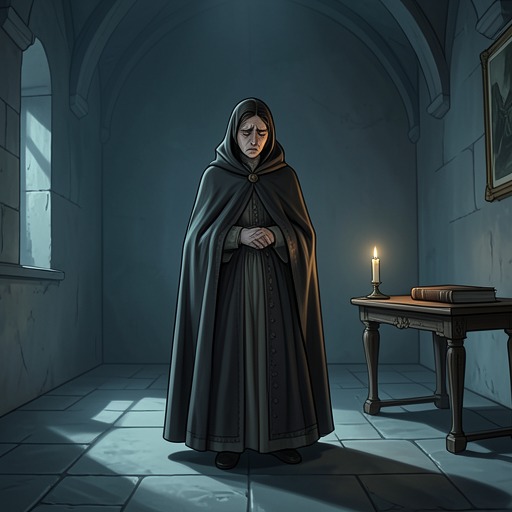
Sansa’s place at court is defined by contradiction. She is still expected to perform the manners of a highborn lady, attend the king, dress beautifully, and speak respectfully, but the political order that once promised her a royal future has become the mechanism of her confinement. On the morning of Joffrey’s name day, she watches the great red comet from her tower window and asks Ser Arys Oakheart what it means. He interprets it as a sign of glory for her betrothed and says that the smallfolk have named it King Joffrey’s Comet. Sansa’s response is inward and far less secure: her mother and Robb Stark are now enemies of the king, her father has died by royal command, and she fears that her family may be next. The red comet therefore becomes a divided emblem, at once a public banner for Joffrey and a private image of blood and threatened loss.
Her appearance at the name-day tourney shows how thoroughly political violence has entered ordinary ceremony. Sansa takes special care with her face and clothing because she knows Joffrey will require her attendance. She wears a pale purple silk gown with long sleeves to hide bruises on her arms, and a moonstone hair net given by Joffrey; the bruises are also described as gifts from him, inflicted after his rage at hearing that Robb had been proclaimed King in the North. The garments preserve the outward image of a favored court lady while concealing the evidence of abuse. This division between visible composure and hidden injury becomes one of Sansa’s central modes of existence.
Life Under Royal Violence
Sansa’s relationship with the Kingsguard illustrates the narrow scale on which she must measure safety. She prefers Ser Arys Oakheart because he is courteous and speaks to her as a person. He once objected when Joffrey ordered him to strike her, although he ultimately obeyed and hit her less hard than Ser Meryn Trant or Ser Boros Blount might have. The other knights appear to her as different varieties of danger: Ser Boros is short-tempered, Ser Meryn cold, Ser Mandon Moore’s dead eyes make her uneasy, and Ser Preston Greenfield treats her like a foolish child. Even limited hesitation inside an abusive institution becomes meaningful to her, because the king’s command has made brutality routine and almost all formal protectors subordinate to it.
That limited refuge collapses when Ser Boros tears open Sansa’s bodice before the court and Joffrey orders that she be beaten so that her brother will suffer through her humiliation. Tyrion Lannister intervenes, condemning the act as the opposite of chivalry, while his sellsword and a burned-eyed wildling stand beside him and threaten the white-cloaked knights. The scene exposes the court’s ceremonial language as a mask: the men who claim to serve the king are prepared to assault a helpless noblewoman, and Sansa’s body is treated as a political message to Robb. Tyrion’s intervention changes the immediate balance from helpless exposure to temporary protection, but it does not remove the power that made the attack possible.
Sansa’s fear is not confined to the Red Keep. Her experience of the wider war is filtered through reports of hunger, repression, and arbitrary death. In the capital, Jacelyn Bywater warns Tyrion that the city has held for the day but is close to collapse: thieves and murderers roam, disease spreads through the stews along Pisswater Bend, food cannot be bought even with money, and treason is openly discussed in guildhalls and markets. Sansa’s life is thus connected to a city whose public order is failing even while royal ceremony continues. When wealthy merchants gather outside the castle seeking refuge, Cersei Lannister orders that they be driven home and, if necessary, that crossbowmen kill some of them, while forbidding any sortie or opening of the gates. The castle’s protection is revealed as selective and coercive, offering safety to power while turning desperate civilians away.
The war’s brutality is still more stark in Sansa’s contrast with Arya Stark’s experience. Arya learns fear in a storehouse beside the Gods Eye, where she remains for eight days and sees someone die every day while Ser Gregor Clegane chooses prisoners for questioning. Captives too weak to keep pace are killed, women are taken by soldiers, and Ser Gregor publicly beheads a girl who resists repeated abuse. Sansa is not present in that storehouse, but the parallel places both Stark girls inside the same political catastrophe: one is endangered beneath the polished rituals of the capital, the other amid openly lawless military violence. Their different forms of captivity reveal that the war’s supposed order and its naked cruelty are not opposites but adjoining faces of power.
Agency, Secrets, and Survival
Sansa’s growing agency first appears through the discipline of self-presentation. After Joffrey’s attacks, she tells herself that she must learn to hide her feelings better so as not to anger him. This is not genuine submission so much as an imposed survival technique. At the same time, the note hidden beneath her pillow offers a radically different possibility: “Come to the godswood tonight, if you want to go home.” The parchment is folded, unsigned, unsealed, and written in an unfamiliar hand. Sansa reads it repeatedly, unable to identify its sender or determine whether it is a trap. She considers taking it to the queen to prove that she has been obedient, but the pain of the bruise left by Ser Meryn and the promise of home keep the danger unresolved. The message turns freedom into a test of judgment rather than a simple gift.
Her responses to other people also show a mind learning to move between roles. When Arya, traveling under concealment and hardship, insists on investigating a village at dusk, she strikes Gendry and declares, “This kind,” when he laughs at her claim to be a lord’s daughter. The moment belongs to Arya rather than Sansa, but it clarifies the broader Stark pattern of identity under pressure: noble status can become a disguise, a memory, or a source of friction, while practical action matters more than titles. Sansa’s own courtly performance works by the same principle in a quieter register. She survives by making the role others expect useful to herself without allowing that role to define all that she knows.
The wider political world reinforces her education in the difference between claims and force. Renly Baratheon argues that Robert won the Iron Throne with his warhammer and that his own claim is therefore as valid as Robert’s; he promises to confirm Robb’s lands and titles, even allowing him to call himself King in the North, provided Robb bends the knee and gives fealty, loyalty, and service. Petyr Baelish, meanwhile, reacts with unmistakable hunger when Tyrion Lannister offers Harrenhal, one of the richest and most formidable castles in the Seven Kingdoms, despite Petyr’s modest birth and his earlier rejection by House Tully. These bargains teach the same lesson that Sansa learns through pain: public words such as honor, kingship, marriage, and loyalty matter only when backed by material power, and every favor creates an obligation.
Betrothal, Release, and Change
Sansa’s political captivity reaches its decisive turn when the Faith declares that her marriage contract with Joffrey is no longer valid. The High Septon argues that King Robert’s agreement was made before House Stark’s alleged crimes were revealed and that those crimes have freed Joffrey from the promise. The throne room erupts in cheers for Margaery Tyrell, while Sansa grips the wooden rail of the gallery. She understands that Joffrey is expected to release her, but fear remains because his previous cruelty has taught her that public necessity does not always restrain him. Her memory returns to the marble steps outside the Great Sept of Baelor, where she once waited for Joffrey to show mercy to her father and instead heard him command Ser Ilyn Payne to execute him. The present ceremony is therefore haunted by the earlier failure of royal compassion.
Joffrey finally says that he is free to follow his heart and will marry Margaery, pleasing the Tyrells and the cheering court. Sansa feels light-headed because she is, at last, free of the immediate betrothal, yet the freedom must be concealed. She reminds herself not to smile because Cersei has warned her that her public face must appear distraught. This is a crucial transformation: Sansa’s inner response and outward performance have become deliberately separate. Earlier, she tried to maintain courtesy because she still believed in the ideals attached to princely conduct; now she understands composure as armor. The release is real, but it is not yet independence. She has escaped one formal claim upon her without escaping the court that made her vulnerable.
Narrative Role and Significance
Sansa’s arc gives political power an intimate, bodily scale. The red comet, the silk sleeves hiding bruises, the unsigned parchment beneath her pillow, the torn gown before the throne, and the wooden rail she grips during the annulment are all concrete forms of a conflict between spectacle and truth. Around her, rulers distribute castles, ships, letters, titles, and military allegiance: Davos Seaworth is ordered to carry Stannis Baratheon’s letters along the coast and nail them to the doors of septs and inns; Xaro Xhoan Daxos is asked for ships and answers with a marriage proposal; Renly offers confirmation of lands in exchange for homage. Sansa, by contrast, is herself treated as a political asset, and her movement from betrothed princess to released hostage exposes the human cost behind these exchanges.
She is also a character of developing complexity rather than a fixed emblem of innocence. Her early longing for home and fear for her mother and brothers coexist with increasingly exact observations of cruelty, rank, and motive. She notices which Kingsguard knights are more dangerous, recognizes that a secret invitation may conceal peril, and learns that a visible expression can be safer than an honest one. Her survival does not come through military strength or formal authority. It comes through attention, restraint, memory, and the ability to preserve an inner judgment while performing obedience outwardly. By the end of the supplied material, Sansa has not won power, but she has gained a clearer understanding of its grammar: kingship is ceremony backed by force, freedom may be granted for political convenience, and the face shown to the world can itself become a weapon.